SILENT SPRING INSTITUTE
Environment and Breast Cancer: Science Review
www.silentspring.org/sciencereview
Environment and Breast Cancer: Science Review
www.silentspring.org/sciencereview


2,4-diaminoanisole sulfate
CAS RN 39156-41-7
CAS RN 39156-41-7
Originating list
Carcinogenicity Potency Database, National Toxicology Program 11th Report on Carcinogens
Carcinogenicity Potency Database, National Toxicology Program 11th Report on Carcinogens
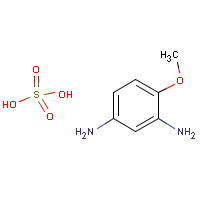
Image from the National Library of Medicine
Associated chemicals
none
none
Major use
Dye
Dye
Widespread exposure
More Likely
More Likely
Human exposure summary
An aromatic amine which was used extensively in hair dyes and in the dyeing of furs until the late 1970s (IARC 2001 vol.:79 p.621). 2,4-diaminoanisole sulfate is a component of cosmetic products (NTP 11th ROC). The maximum concentration of the compound in hair-dye preparations is approximately 1.5%.
An aromatic amine which was used extensively in hair dyes and in the dyeing of furs until the late 1970s (IARC 2001 vol.:79 p.621). 2,4-diaminoanisole sulfate is a component of cosmetic products (NTP 11th ROC). The maximum concentration of the compound in hair-dye preparations is approximately 1.5%.
Mammary gland tumor summary
NTP 11th ROC: When administered in the diet to female rats, 2,4-diaminoanisole sulfate induced mammary adenocarcinomas. An NTP study of 2,4-diaminoanisole sulfate did not find mammary gland tumors.
NTP 11th ROC: When administered in the diet to female rats, 2,4-diaminoanisole sulfate induced mammary adenocarcinomas. An NTP study of 2,4-diaminoanisole sulfate did not find mammary gland tumors.
International Agency for Research on Cancer evaluation
IARC classification
2B: Possibly carcinogenic to humans
2B: Possibly carcinogenic to humans
Evidence in humans
inadequate
inadequate
Tumor sites identified in IARC Monographs
thyroid, skin, preputial gland, clitoris, Zymbal glands
thyroid, skin, preputial gland, clitoris, Zymbal glands
Evidence in animals
sufficient
sufficient
US EPA cancer classification
NA
NA
National Toxicology Program Study Conclusions
Female rats
Positive
Positive
Female mice
Positive
Positive
Male rats
Positive
Positive
Male mice
Positive
Positive
Mutagenicity from CPDB
Mutagenic
Mutagenic
Mutagenicity from RTECS
Mutagenic
Mutagenic

